Meme Stratum
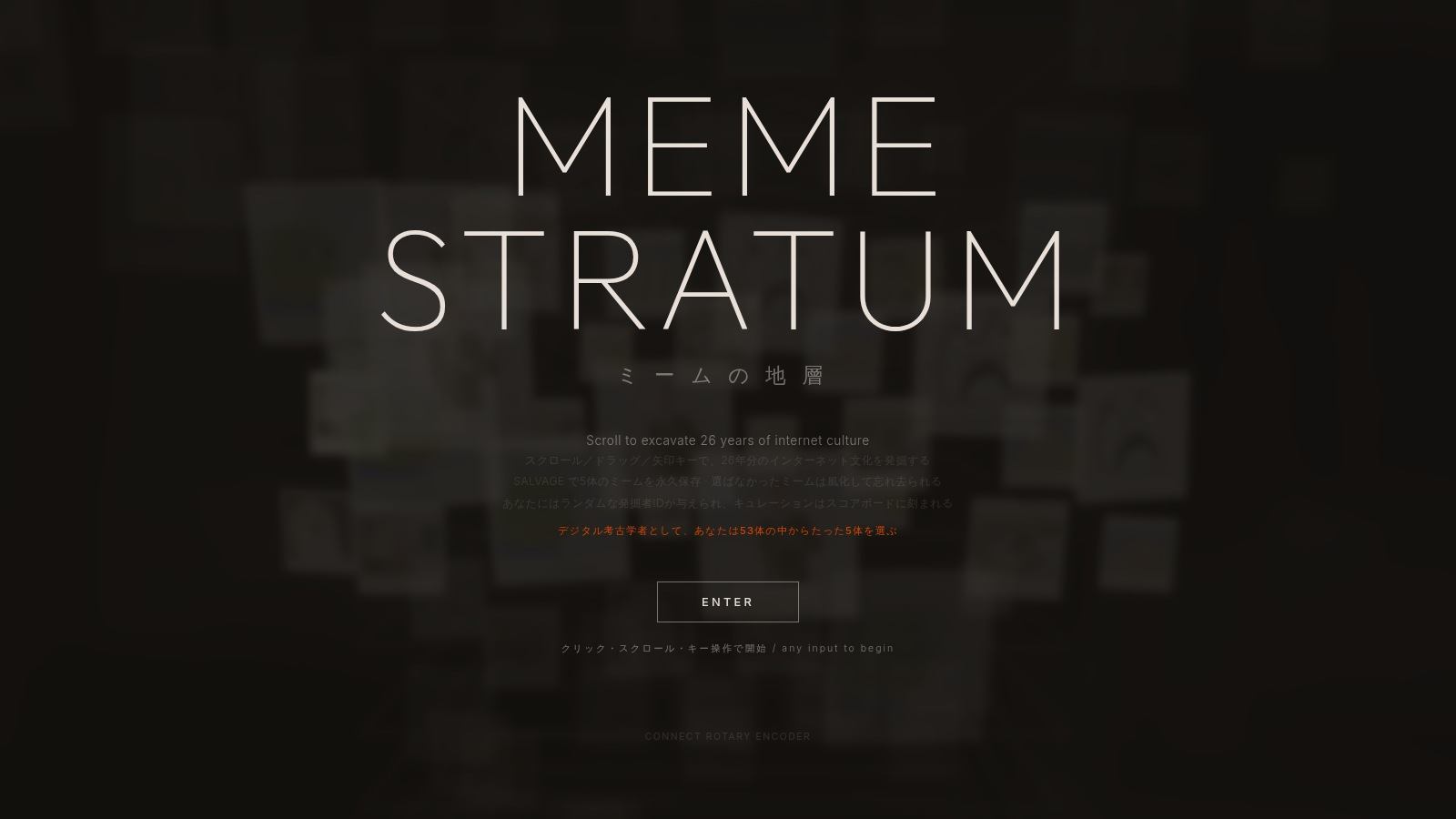
A Three.js installation that turns 26 years of internet memes into geological strata you excavate.


Concept
Meme Stratum treats internet culture as sediment. 53 memes from 2000 to 2026 hang in a 3D space as sheets of paper pinned to a wall, and the Z axis is time: scroll, and you dig down through the layers of the last 26 years.
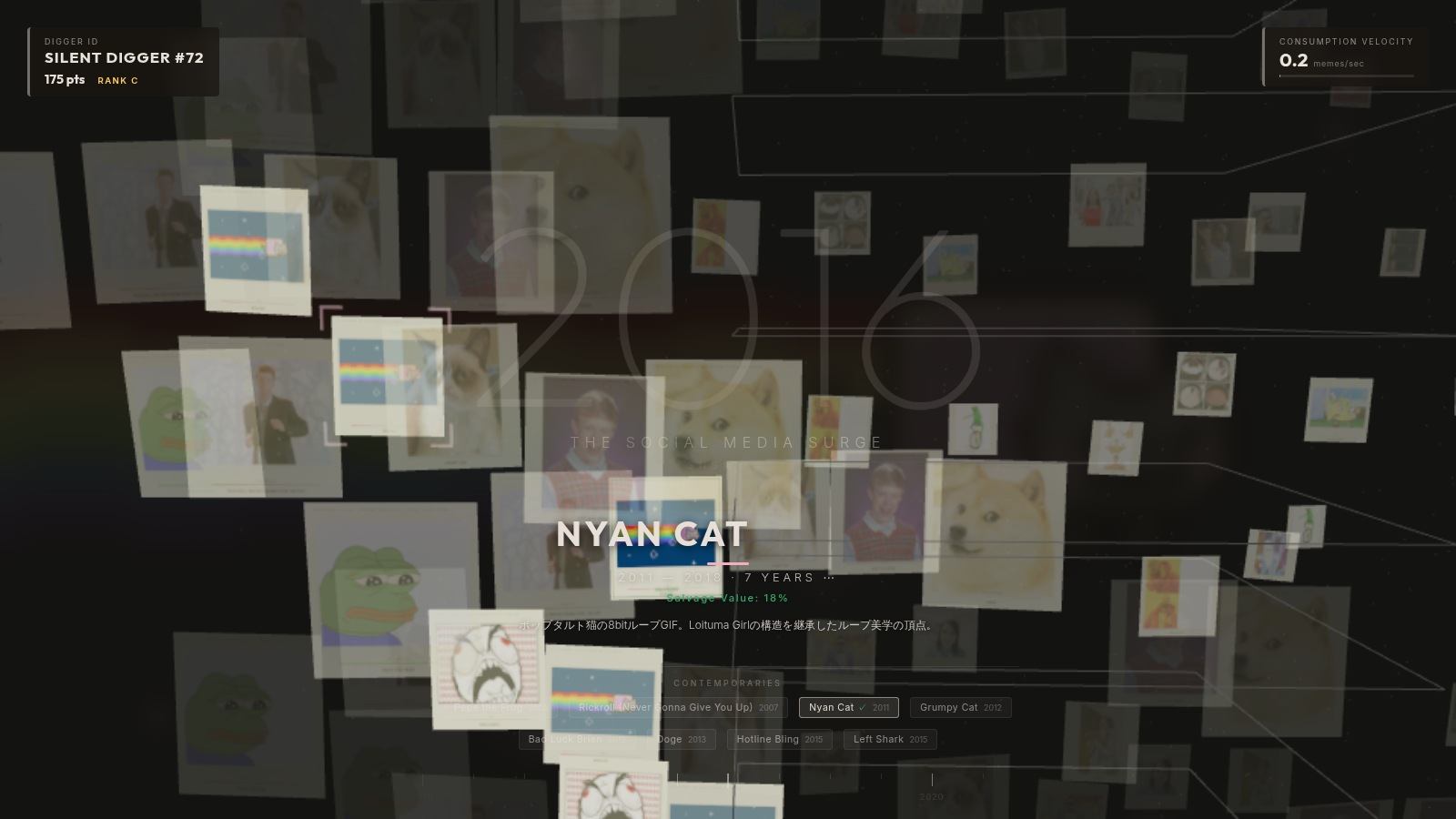
The piece is a critique dressed as an excavation. The visitor is handed a finite attention budget — five salvages, out of fifty-three fossils — and everything they do not choose is left to decay. A counter in the corner keeps score of how many memes went past unread while they were scrolling.
Space as Time
- Z axis is the year. 2000 sits at the far end of the tunnel, 2026 at the viewer.
- X axis is a ten-lane round robin, with memes stacking vertically inside a lane when a year gets crowded.
- Panel size grows exponentially with lifespan, so a meme that burned out in a year is a scrap and one that survived two decades is a poster. Rickroll looms; Harlem Shake is a receipt.
- Trails run from a meme’s birth year to its death year, so a long life reads as a long thread through the space.
- Each panel is drawn into a 512×512 canvas at runtime: paper grain, a pin, the image, a lifespan bar, the label — then aged by a factor that yellows the paper, adds stains and wears the corners the further back it sits.
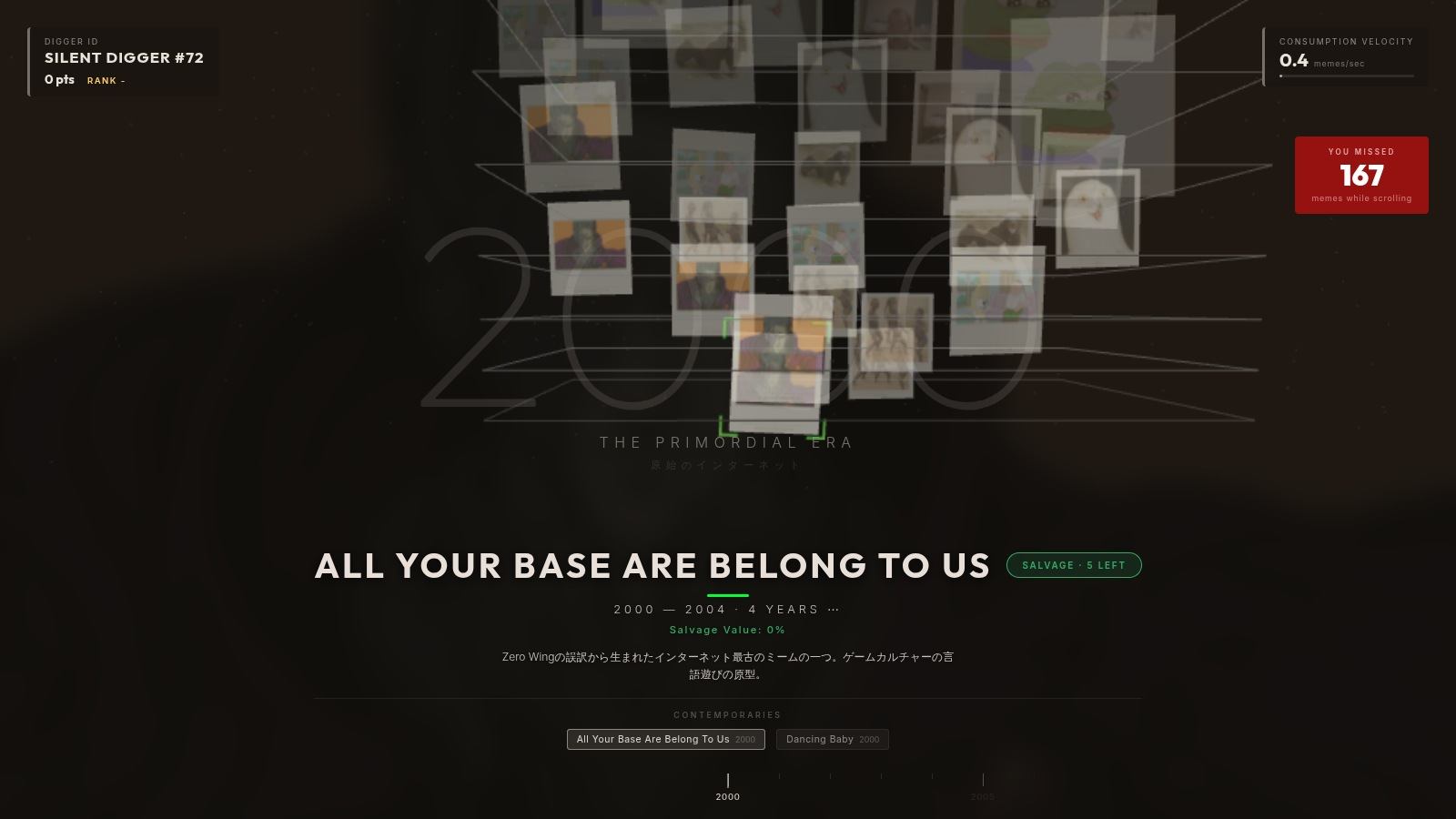
The timeline is cut into six named eras — The Primordial Era, The Viral Video Age, The Golden Age, The Social Media Surge, The Post-Ironic Era, The Algorithmic Age — that swap under a giant typographic year as you travel.
Rules of the Dig
Every fossil carries a rarity derived from how it died, not how famous it was: a meme that faded slowly outranks one that died overnight, and a meme that came back from the dead (Pepe, Doge, Rickroll) outranks both.
| Rarity | Curation score |
|---|---|
| MYTHIC | 100 |
| RARE | 50 |
| UNCOMMON | 25 |
| DISPOSABLE | 10 |
Salvaging two fossils that died the same way pays a combo bonus, which quietly pushes the visitor from “grab the famous ones” toward actually reading the deaths. The session ends in a consumption report: what you consumed, what you saved, what you missed, and a grade — Conscious Consumer, Attention Deficit, Binge Consumer, Casual Scroller — with a rank from D to S.

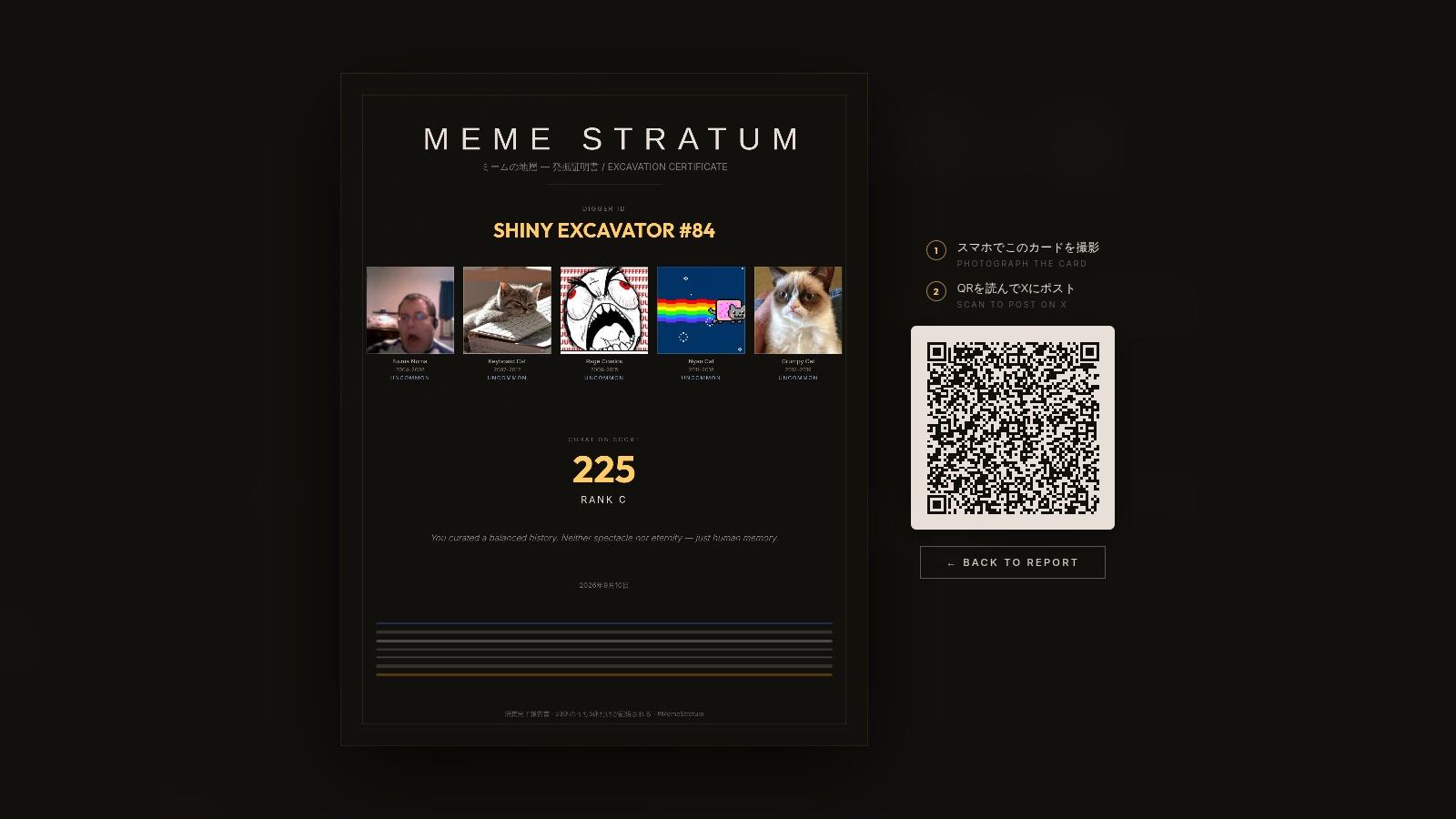
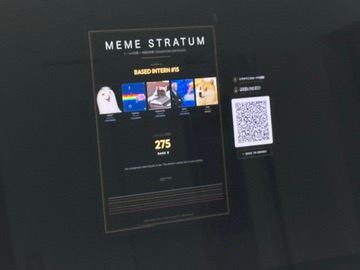
Every visitor is assigned a random digger ID on arrival (SHINY EXCAVATOR #84), which is what lands on the Hall of Diggers scoreboard. Over an exhibition day the board turns strangers into competitors.
Built to Be Left Alone
An exhibition piece has to survive a room full of people and a day without a curator.
- Attract mode. After 20 seconds of silence the camera drifts on its own and loops the strata, then hands control back the instant anyone touches anything.
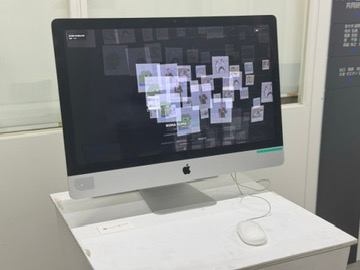
- No network. Every meme image and font is bundled into the build, and the exhibition machine serves the prebuilt
dist/from a double-clickable script — no Node, no npm, no internet. - Kiosk discipline. Chrome starts full screen with sleep suppressed, restore dialogs off and autoplay allowed.
- A render budget. On a 5K iMac the piece caps its own render resolution and drops backdrop blur, then trims quality further at runtime if frames still drop — so the drone never stutters in front of a visitor.
The sound is a single low drone built in the Web Audio API — a triangle at 55 Hz over a sine at 27.5 Hz through a lowpass — whose pitch falls as you descend into older years and whose filter opens with your scroll speed. You hear how fast you are consuming before you read the meter.
A Knob Instead of a Mouse Wheel
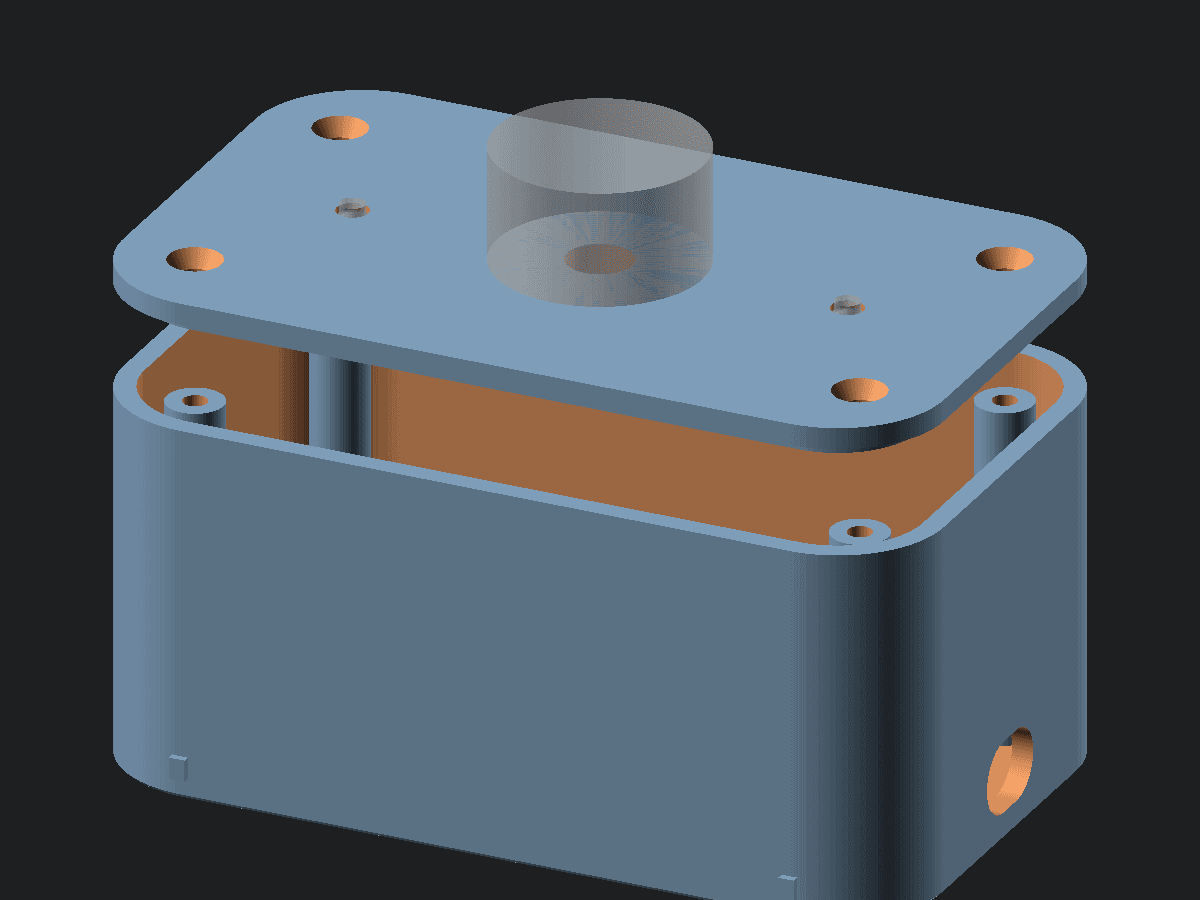
Scrolling geology with a mouse felt wrong, so the piece also speaks Web Serial. A rotary encoder on a Pico W streams its delta over USB and the strata turn under your hand. The controller ships as firmware in both CircuitPython and Arduino flavours, in a parametric two-piece OpenSCAD enclosure printed for the show.